

By [Author Name] — Veteran journalist covering global migration and economic trends
Updated April 29, 2026
Considering a long-term stay in Malaysia? The Malaysia My Second Home (MM2H) program offers a unique pathway to living in Malaysia on a long-term social visit pass. This guide cuts through the noise, providing a timeless overview of the program’s core benefits, fundamental requirements, and the application process, helping you make an informed decision about making Malaysia your second home.
Key Takeaways
- MM2H offers a long-term social visit pass, not permanent residency or citizenship.
- The program provides a stable, attractive option for those seeking extended stays in Malaysia.
- Financial stability and a clean background are consistent core requirements.
- Benefits include property ownership, vehicle purchase incentives, and domestic helper employment.
- Policy specifics can evolve; always consult official Malaysian government sources for the latest regulations.
What is the Malaysia My Second Home (MM2H) Program?
The Malaysia My Second Home (MM2H) program is a government initiative designed to allow foreigners who meet specific criteria to live in Malaysia on a long-term social visit pass. This pass is typically valid for five years and is renewable, offering a stable pathway for individuals and their families to experience Malaysia’s lifestyle without requiring employment or business setup.
Launched in 2002, MM2H aims to attract financially capable individuals seeking a relaxed, affordable, and culturally rich environment for their retirement or extended stay. It is managed by the Ministry of Tourism, Arts and Culture (MOTAC) or the Ministry of Home Affairs (KDN), depending on the specific program variant in effect. The program is not a path to permanent residency or citizenship, but rather a long-term visa that simplifies extended living in Malaysia.
Why Consider MM2H for Long-Term Residency?
Many individuals choose the MM2H program for its compelling blend of lifestyle advantages, economic opportunities, and cultural immersion. Malaysia consistently ranks high for expatriate living due to its low cost of living, excellent healthcare infrastructure, and diverse cultural landscape, making it an attractive destination for long-term residents.
The program’s appeal rests on several pillars. For one, Malaysia boasts a tropical climate year-round, appealing to those escaping colder climes. Its strategic location in Southeast Asia also provides easy access to other regional destinations, a significant draw for avid travelers. Furthermore, the country’s multicultural society, with Malay, Chinese, and Indian influences, offers a rich tapestry of experiences, from diverse cuisines to vibrant festivals. A 2023 survey by Internations found that 78% of expats in Malaysia were satisfied with their financial situation, citing the favorable cost of living as a primary factor.
What Are the Core Benefits of the MM2H Program?
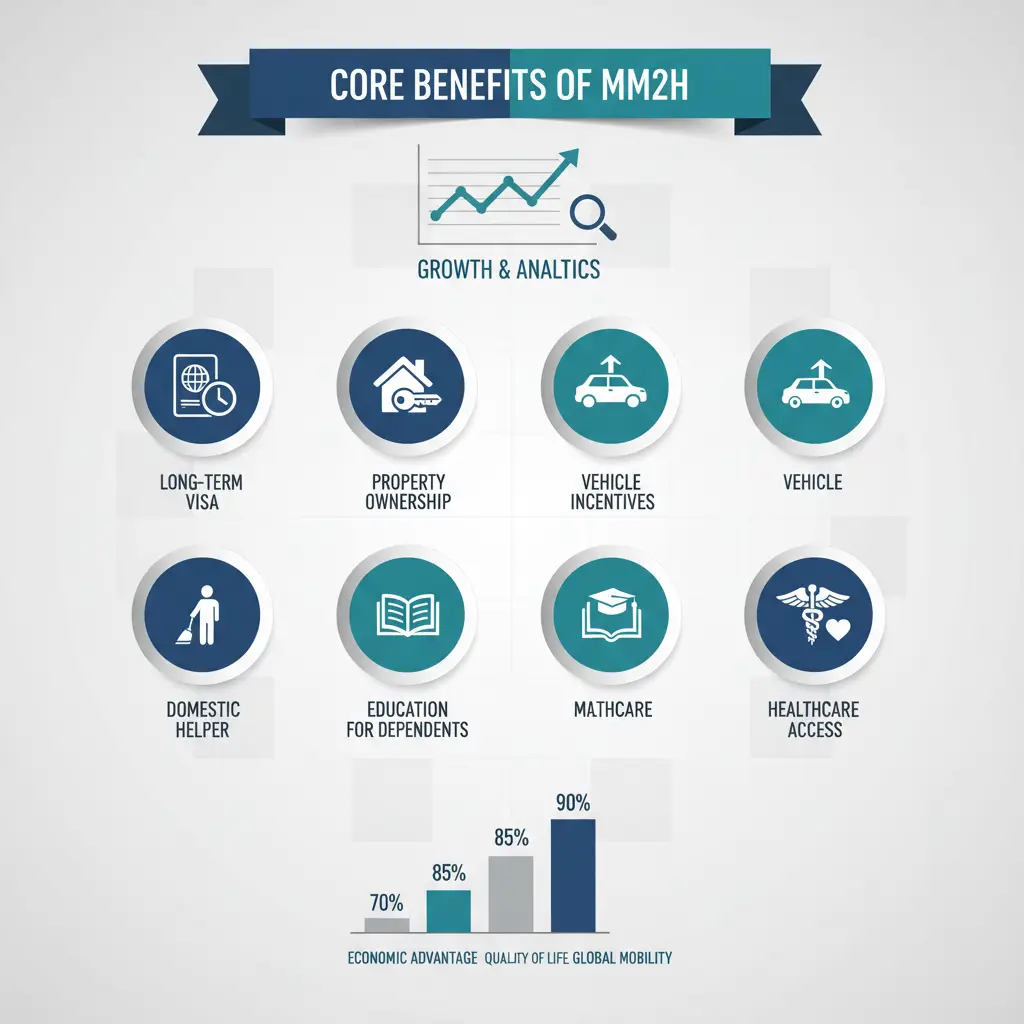
The MM2H program offers a suite of benefits designed to make long-term living in Malaysia comfortable and convenient for participants. These advantages extend beyond just the visa itself, touching upon financial, lifestyle, and practical aspects of expatriate life.
Here’s a breakdown of the key benefits:
- Long-Term Stay: Participants receive a multi-entry social visit pass, typically for five years, renewable for subsequent five-year periods. This eliminates the need for frequent visa renewals or border runs.
- Property Ownership: MM2H participants are generally permitted to purchase residential properties in Malaysia, subject to state-specific minimum price thresholds. This allows for investment and a stable living arrangement.
- Vehicle Purchase Incentives: The program often includes incentives for purchasing a locally assembled or imported car, though these specifics can vary and should always be verified with the latest guidelines.
- Domestic Helper Employment: Participants can apply for a work permit for one domestic helper, simplifying household management.
- Education for Dependents: Dependent children under a certain age (e.g., 21 or 34, depending on the variant) can study in Malaysia at private schools or universities.
- Healthcare Access: While not providing free healthcare, participants gain access to Malaysia’s high-quality and affordable private healthcare facilities. Mandatory health insurance is typically a requirement.
- Business & Investment Opportunities: While the primary MM2H pass does not permit employment, participants may be allowed to engage in certain types of business or investment activities, subject to specific conditions and approvals.
- Repatriation of Funds: Participants can repatriate their offshore income and capital gains to Malaysia without issue.
These benefits collectively create an attractive package for individuals seeking a long-term base in Southeast Asia. For instance, the ability to own property provides a sense of permanence and potential investment growth. A 2024 report by Knight Frank indicated that property values in prime Malaysian locations saw an average annual appreciation of 3.5% over the last five years, offering a tangible benefit for MM2H participants investing in real estate.
How Does the MM2H Application Process Work?
The MM2H application process typically involves several stages, from initial submission to final approval and activation of the visa. While specific documents and financial thresholds can change, the fundamental steps and principles of demonstrating financial stability and good standing remain consistent.
Here’s a general outline of the process:
- Preparation of Documents: Gather all required personal and financial documents, including proof of income, liquid assets, bank statements, medical reports, and police clearance certificates.
- Submission of Application: Submit the complete application package to the relevant Malaysian government agency (e.g., MOTAC or KDN), either directly or through an authorized agent.
- Conditional Approval: If successful, applicants receive a Conditional Approval Letter. This letter outlines the remaining conditions to be fulfilled, such as opening a fixed deposit account in Malaysia and purchasing health insurance.
- Fulfillment of Conditions: Travel to Malaysia to fulfill the conditions stated in the Conditional Approval Letter. This usually involves opening the fixed deposit account, undergoing a medical examination, and purchasing health insurance.
- Issuance of MM2H Visa: Once all conditions are met and verified, the MM2H social visit pass is endorsed in the applicant’s passport.
The processing time can vary significantly, ranging from a few months to over a year, depending on the program variant, the completeness of the application, and government processing loads. A 2023 survey of MM2H agents indicated an average processing time of 6-9 months for complete applications under the current framework.
What are the Key Requirements for MM2H Eligibility?
Eligibility for the MM2H program hinges on demonstrating financial capability, a clean background, and good health. While the specific financial thresholds and age categories have seen adjustments over the years, the underlying principle is to ensure applicants can comfortably support themselves and their dependents in Malaysia without seeking employment.
The requirements typically fall into several categories:
Financial Requirements
Applicants must show proof of sufficient liquid assets and a consistent offshore income. For example, previous iterations of the program required applicants under 50 years old to show proof of RM500,000 (approximately USD 105,000) in liquid assets and an offshore income of RM10,000 (approximately USD 2,100) per month. Those aged 50 and above often had slightly lower requirements, such as RM350,000 (approximately USD 73,000) in liquid assets and the same RM10,000 offshore income. These figures are illustrative; the current program variant, often referred to as ‘MM2H 2.0’ or specific state-based programs like Sarawak MM2H, will have their own distinct and mandatory requirements. For instance, the current MM2H 2.0 requires a minimum offshore income of RM40,000 per month (approximately USD 8,400) and a fixed deposit of RM1 million (approximately USD 210,000) for all age groups, a significant increase from earlier versions. For the most up-to-date MM2H financial requirements, it is essential to consult official government sources.
Fixed Deposit Requirements
Upon conditional approval, applicants are required to open a fixed deposit account with a Malaysian bank. The amount varies by program variant and age group. A portion of this fixed deposit may be allowed for withdrawal after one year for approved expenses like property purchase, healthcare, or education, subject to government approval. This fixed deposit serves as a guarantee of the applicant’s financial stability within Malaysia.
Medical & Security Requirements
All applicants and their dependents must undergo a medical examination in Malaysia and obtain medical insurance from a Malaysian provider. A Certificate of Good Conduct or police clearance from their country of origin is also mandatory, ensuring applicants have no criminal record. This aspect of the application is non-negotiable, emphasizing the program’s commitment to safety and public health.
Age Requirements
Historically, the MM2H program had two main age categories: under 50 and 50 and above, with differing financial requirements. The current MM2H 2.0 program has streamlined this, often applying uniform financial criteria across all age groups, though specific state programs might retain age-based distinctions. Always consult the official guidelines for the precise age criteria applicable at the time of your application.
These stringent requirements ensure that only genuinely qualified and financially secure individuals are granted the MM2H visa. The Malaysian government’s intent is to attract individuals who will contribute positively to the local economy and society.
MM2H vs. Other Long-Term Visa Options: A Comparison
While MM2H is a popular choice for long-term residency, it’s crucial to understand how it compares to other potential visa pathways in Malaysia. Each option serves different purposes and has distinct requirements, catering to various individual circumstances.
Here’s a comparison of MM2H with other common long-term visa types:
| Feature | Malaysia My Second Home (MM2H) | Employment Pass (EP) | Dependent Pass | Student Pass |
|---|---|---|---|---|
| Purpose | Long-term stay, retirement, lifestyle | Work for a Malaysian company | Accompanying EP/MM2H holder | Study at Malaysian educational institution |
| Eligibility | Financial stability, clean background | Job offer from Malaysian company, specific skills/qualifications | Relationship to primary pass holder | Admission to Malaysian institution, financial proof |
| Duration | 5 years (renewable) | 1-5 years (renewable) | Tied to primary pass holder’s validity | Duration of study program |
| Right to Work | Generally no (some exceptions for specific variants/approvals) | Yes, for sponsoring company | Generally no (may apply for EP separately) | Generally no (limited part-time work may be allowed for specific categories) |
| Fixed Deposit | Required (significant amount) | Not required | Not required | Proof of funds for tuition/living |
| Property Ownership | Permitted (subject to state limits) | No direct provision based on EP | No direct provision | No direct provision |
| Dependents | Spouse, unmarried children (up to specific age) | Spouse, unmarried children (up to 18/21) | N/A (they are dependents) | Spouse, unmarried children (limited cases) |
| Governing Body | MOTAC/KDN | Immigration Department | Immigration Department | Immigration Department |
This table highlights that MM2H is uniquely positioned for those seeking a long-term, non-employment-based stay, emphasizing lifestyle and investment. In contrast, an Employment Pass is strictly tied to a job, and Dependent/Student Passes are ancillary to a primary purpose. For example, a 2022 report by the Immigration Department of Malaysia showed over 1.5 million active Employment Pass holders, dwarfing the MM2H participant numbers, underscoring their distinct purposes.
Navigating Policy Changes: A Future-Proof Approach to MM2H
The MM2H program has undergone several policy revisions since its inception, reflecting governmental adjustments to economic conditions and national priorities. While this guide focuses on enduring principles, understanding how to approach these changes is crucial for any prospective applicant.
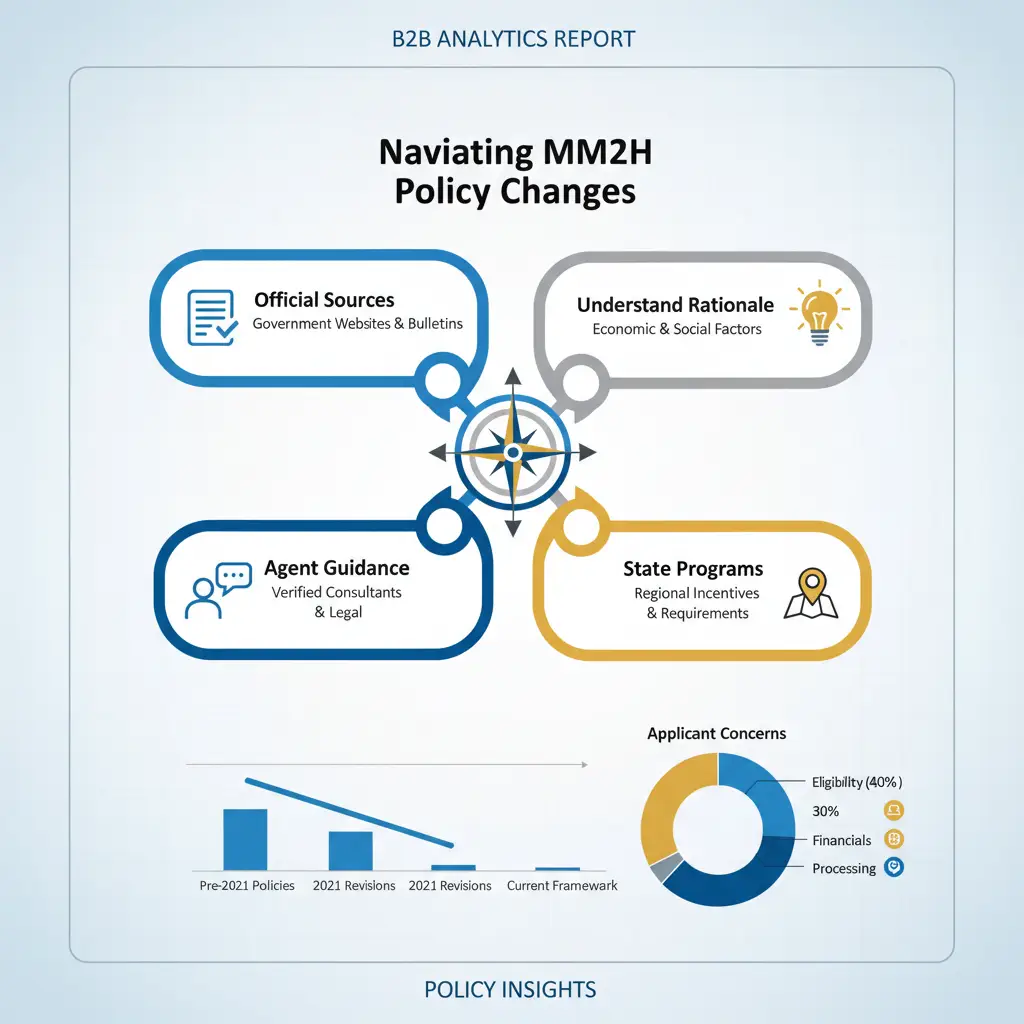
Here’s how to navigate policy shifts effectively:
- Always Consult Official Sources: The single most important rule is to rely solely on information from official Malaysian government websites (e.g., MOTAC, Immigration Department) or directly from accredited MM2H agents. Unofficial forums or outdated websites can provide misleading information.
- Understand the ‘Why’: Policy changes often stem from specific objectives, such as attracting higher-net-worth individuals, addressing economic concerns, or streamlining administration. Understanding the rationale can help anticipate future directions.
- Distinguish Between Core Principles and Specifics: The core intent of MM2H—attracting financially stable individuals for long-term stays—remains constant. What changes are the specific financial thresholds, age limits, or application procedures.
- Consider State-Specific Programs: Some states, like Sarawak, operate their own MM2H programs (S-MM2H) with potentially different, and sometimes more accessible, requirements. These programs often run concurrently with the federal MM2H.
- Engage Accredited Agents: For complex applications or when policy is in flux, an accredited MM2H agent can be invaluable. They are typically up-to-date with the latest regulations and can guide you through the intricacies. The Malaysian government maintains a list of licensed agents; ensure any agent you consider is on this official list.
For example, the introduction of the ‘MM2H 2.0’ in 2021 brought more stringent financial requirements, leading to a temporary slowdown in applications. However, subsequent adjustments and the continued operation of programs like S-MM2H demonstrate the government’s ongoing commitment to the program, albeit with evolving parameters. The key is adaptability and diligent verification of information. For a deeper understanding of the policy review implications for expats and investors, further resources are available.
Frequently Asked Questions About MM2H
Prospective applicants often have specific questions about the nuances of the MM2H program. Here are answers to some of the most common inquiries, designed to provide clarity and address adjacent concerns.
Can MM2H lead to permanent residency or citizenship?
No, the MM2H program is strictly a long-term social visit pass and does not offer a pathway to permanent residency or Malaysian citizenship. It is designed for extended stays, not immigration.
Are there any age restrictions for MM2H applicants?
While previous versions of the MM2H program had distinct age categories (under 50 and 50+), the current MM2H 2.0 program often applies uniform financial requirements across all age groups. However, specific state-level MM2H programs might still have age-based distinctions. Always check the latest official guidelines.
Can I work in Malaysia with an MM2H visa?
Generally, the MM2H visa does not permit employment in Malaysia. However, there have been instances or specific program variants that allow limited part-time work for certain age groups or participation in specific business activities, subject to explicit government approval. Verify current regulations carefully.
What happens if I want to withdraw my fixed deposit early?
A portion of the fixed deposit can typically be withdrawn after one year for approved expenses such as property purchase, medical expenses, or children’s education. Any withdrawal requires prior approval from the MM2H Centre and submission of supporting documents. The remaining balance must always meet the program’s minimum requirement.
Is health insurance mandatory for MM2H?
Yes, it is a mandatory requirement for all MM2H participants and their dependents to obtain and maintain valid medical insurance from a Malaysian insurance provider. This ensures access to healthcare services during their stay.
Can my family join me under the MM2H program?
Yes, the MM2H program allows for dependents, typically including your spouse and unmarried children up to a certain age (e.g., 34 years for MM2H 2.0, with specific conditions). Parents or parents-in-law may also be included under certain circumstances, often requiring additional financial provisions.
How long does the MM2H application process take?
The processing time can vary significantly, from a few months to over a year, depending on the specific program variant, the completeness of your application, and the current workload of the processing government agency. It is advisable to plan accordingly and factor in potential delays.
The Enduring Appeal of Malaysia My Second Home
The Malaysia My Second Home (MM2H) program, despite its evolving regulations, continues to hold a strong appeal for individuals seeking a long-term, stable residency option in Southeast Asia. Its fundamental promise of an affordable, culturally rich, and comfortable lifestyle in a strategically located country remains intact.
While specific financial thresholds and application procedures may shift, the core benefits—such as property ownership, access to quality healthcare, and the ability to bring dependents—are consistent draws. The key to a successful application and a fulfilling long-term stay lies in diligent research, adherence to official guidelines, and a proactive approach to understanding any policy adjustments. Malaysia offers a compelling proposition for those ready to embrace its vibrant culture and relaxed pace of life as their second home.
Last updated: April 29, 2026
 English
  Chinese (Taiwan)
  Chinese (China)