
马来西亚我的第二家园 (MM2H):您的长期居住终极指南

By Alex Chen — Veteran journalist covering global finance, economics, and lifestyle trends for over 15 years.

Updated April 30, 2026

Malaysia beckons with a promise: a vibrant, affordable, and culturally rich life for those seeking a long-term haven. The Malaysia My Second Home (MM2H) program isn’t merely a visa; it’s an invitation to integrate into a dynamic society, enjoy a tropical climate, and benefit from world-class amenities at a fraction of Western costs. For many, it represents the ideal blend of adventure and stability, offering a unique opportunity to redefine retirement or simply embrace a different pace of life.

Key Takeaways

  • The MM2H program offers a long-term, renewable social visit pass for non-Malaysian citizens, allowing them to reside in the country.
  • It’s designed for individuals seeking a second home or retirement destination, emphasizing financial stability and a clean background.
  • Beyond the visa, MM2H provides access to Malaysia’s affordable healthcare, diverse culture, and low cost of living.
  • Recent program updates have introduced stricter financial requirements, aiming to attract higher-net-worth individuals.
  • Understanding the lifestyle implications—from education to cultural integration—is as crucial as navigating the application process.

What is the Malaysia My Second Home (MM2H) Program?

The Malaysia My Second Home (MM2H) program is a government initiative that grants non-Malaysian citizens a long-term, multiple-entry social visit pass, allowing them to reside in Malaysia for an extended period. This program is specifically designed to attract affluent individuals and families who wish to make Malaysia their second home, offering a blend of tropical lifestyle, economic stability, and cultural diversity.

Initially launched in 2002, MM2H has evolved to meet changing global demands and national objectives, providing a structured pathway for foreigners to enjoy the country’s benefits without relinquishing their original citizenship. It’s not a permanent residency or citizenship program, but rather a long-term visa that simplifies living, working (under specific conditions), and investing in Malaysia.

Who is the MM2H Program Designed For?

The MM2H program is primarily designed for individuals and families who are financially independent and seeking a long-term stay in Malaysia, whether for retirement, a change of lifestyle, or a base for regional travel. It targets those who can contribute positively to the Malaysian economy and society, ensuring participants have the means to support themselves without burdening public services.

This includes retirees looking for a warm climate and lower cost of living, digital nomads seeking a vibrant hub, and families desiring quality education and a multicultural environment for their children. Participants typically value stability, accessibility, and the unique blend of modern infrastructure and natural beauty that Malaysia offers. A 2023 survey by PropertyGuru indicated that 65% of potential foreign buyers in Malaysia cited MM2H as a significant factor in their interest, highlighting its role in attracting long-term residents.

What Are the Eligibility Requirements for MM2H?

Eligibility for the MM2H program centers on financial capability, age, and a clean background, with specific criteria varying slightly between the Peninsular Malaysia MM2H and the Sarawak MM2H programs. Applicants must demonstrate sufficient liquid assets and a consistent offshore income, alongside fulfilling health and security checks.

The program underwent significant revisions in 2021, introducing more stringent conditions. For Peninsular Malaysia MM2H, applicants generally need to show offshore income of at least RM40,000 per month (approximately USD 8,500), liquid assets of RM1.5 million (approximately USD 320,000), and a fixed deposit of RM1 million (approximately USD 213,000) upon approval. The Sarawak MM2H, managed by the Sarawak state government, often has slightly more relaxed financial requirements, reflecting its aim to boost the local economy. These requirements underscore Malaysia’s intent to attract high-net-worth individuals who can contribute meaningfully to the local economy.

Key Financial Requirements (Peninsular MM2H)

Meeting the financial thresholds is the cornerstone of a successful MM2H application. These requirements ensure that participants are self-sufficient and can comfortably maintain a high quality of life in Malaysia.

  • Offshore Income: A minimum of RM40,000 per month (approx. USD 8,500). This must be verifiable and consistent.
  • Liquid Assets: Proof of at least RM1.5 million (approx. USD 320,000) in liquid assets, such as savings accounts, fixed deposits, or shares.
  • Fixed Deposit: Upon approval, a fixed deposit of RM1 million (approx. USD 213,000) must be placed in a Malaysian bank. Participants can withdraw up to 50% of this amount after one year for approved expenses like property purchase, healthcare, or education.
  • Age: Applicants must be 35 years old and above.
  • Medical Check-up: A medical report from a Malaysian private hospital or registered clinic is required.
  • Good Conduct: A Letter of Good Conduct from the applicant’s home country police force is mandatory.

These figures, while substantial, are designed to ensure the program attracts individuals who can genuinely enjoy and contribute to the Malaysian lifestyle without financial strain. According to a 2024 report by the Malaysia Tourism Promotion Board, the revised MM2H program aims to generate RM200 million in foreign direct investment annually through these fixed deposits.

Peninsular MM2H vs. Sarawak MM2H: A Comparison

While both programs offer long-term residency, the Sarawak MM2H program presents a distinct set of criteria tailored to the state’s specific development goals. Understanding these differences is crucial for prospective applicants to choose the most suitable pathway.

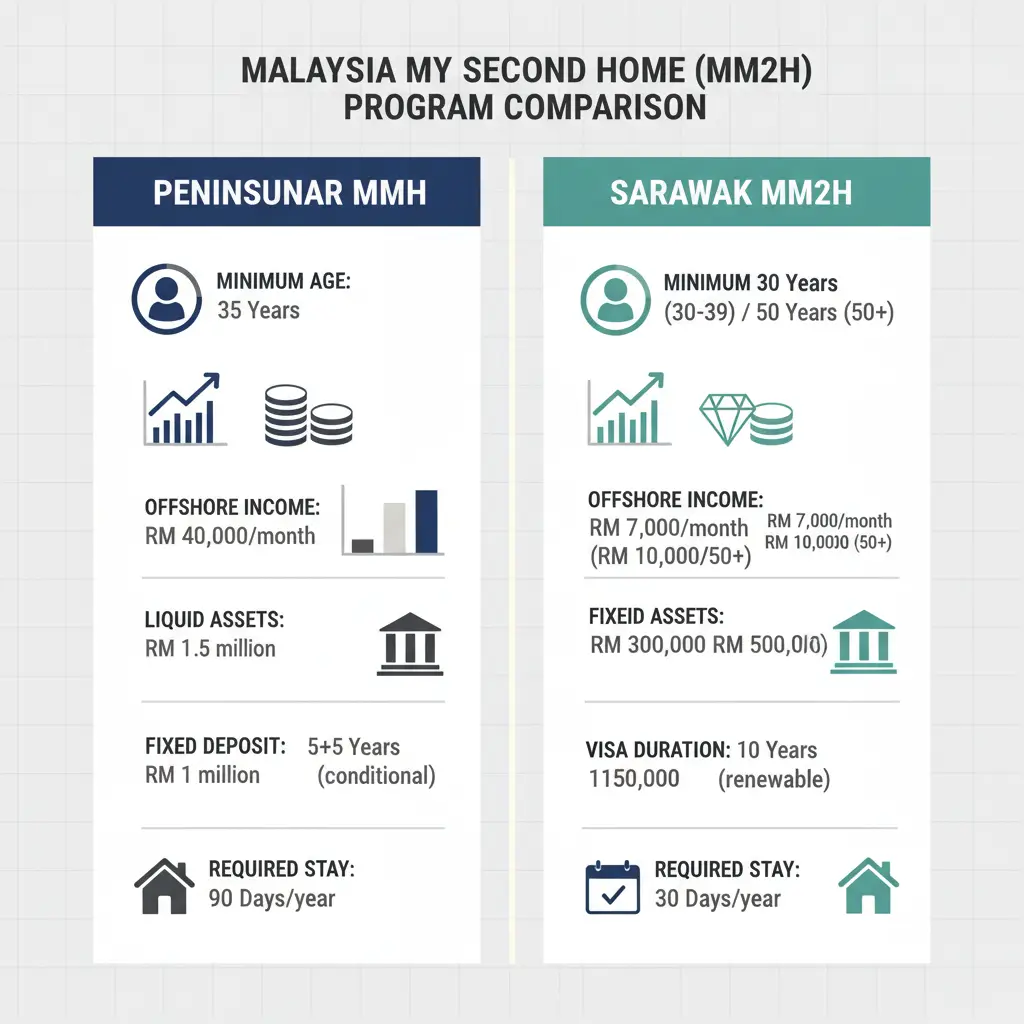
The Sarawak MM2H program generally offers lower financial thresholds and a more streamlined application process, making it an attractive option for those who find the Peninsular MM2H requirements too stringent. However, participants under the Sarawak MM2H are typically expected to reside primarily in Sarawak. Here’s a quick comparison:

Infographic comparing Peninsular MM2H vs Sarawak MM2H eligibility requirements for long-term residency in Malaysia

The choice between Peninsular and Sarawak MM2H often depends on an applicant’s financial standing and preferred lifestyle. Sarawak offers a more laid-back, nature-focused experience, while Peninsular Malaysia provides bustling cities and broader infrastructure. A 2025 analysis by the Sarawak Tourism Board reported a 30% increase in MM2H applications for Sarawak following the Peninsular program’s revisions, indicating a shift in applicant preference.

Feature Peninsular MM2H Sarawak MM2H
Minimum Age 35 years 30 years
Offshore Income RM40,000/month RM7,000/month (30-49 years)
RM10,000/month (50+ years)
Liquid Assets RM1.5 million RM300,000 (30-49 years)
RM500,000 (50+ years)
Fixed Deposit RM1 million (can withdraw 50% after 1 year) RM150,000 (30-49 years)
RM300,000 (50+ years)
Duration of Visa 5 years, renewable 10 years, renewable
Required Stay No minimum stay specified Minimum 30 days per year in Sarawak
Property Purchase Allowed, subject to state foreign ownership rules Allowed, subject to state foreign ownership rules

How Does the MM2H Application Process Work?

The MM2H application process involves several distinct stages, from initial document preparation to final approval, typically managed through an authorized agent. While seemingly complex, breaking it down into manageable steps clarifies the journey toward your Malaysian second home.

The process begins with gathering extensive personal and financial documentation, followed by submission to the relevant authorities. It requires meticulous attention to detail and adherence to specific guidelines to avoid delays. The Malaysian government emphasizes transparency and thoroughness in vetting applicants, ensuring only qualified individuals are granted the visa. The average processing time, according to data from the Ministry of Tourism, Arts and Culture (MOTAC) in 2024, is between 90 to 120 working days, though this can vary based on individual circumstances and completeness of documentation.

Step-by-Step Application Guide

  1. Engage an MM2H Agent: While not mandatory, using an authorized agent is highly recommended. They provide expert guidance, ensure all documents are correctly prepared, and liaise with the authorities on your behalf, significantly streamlining the process.
  2. Document Preparation: Gather all required documents, including passport copies, marriage certificates (if applicable), birth certificates of dependents, financial statements (bank statements, income proof), and a Letter of Good Conduct.
  3. Submit Application: Your agent will submit the complete application package to the relevant MM2H Centre (Ministry of Tourism, Arts and Culture for Peninsular MM2H, or Sarawak Tourism Board for Sarawak MM2H).
  4. Conditional Approval: If successful, you will receive a conditional approval letter. This letter outlines the final requirements, such as placing the fixed deposit and undergoing a medical examination.
  5. Fulfill Conditions: Travel to Malaysia (if not already there) to open a fixed deposit account in a Malaysian bank, undergo the required medical check-up, and purchase medical insurance from a Malaysian provider.
  6. Final Endorsement: Submit proof of fulfilling these conditions to the MM2H Centre. Once verified, your MM2H visa will be endorsed in your passport.

What are the Lifestyle Benefits of MM2H Residency?

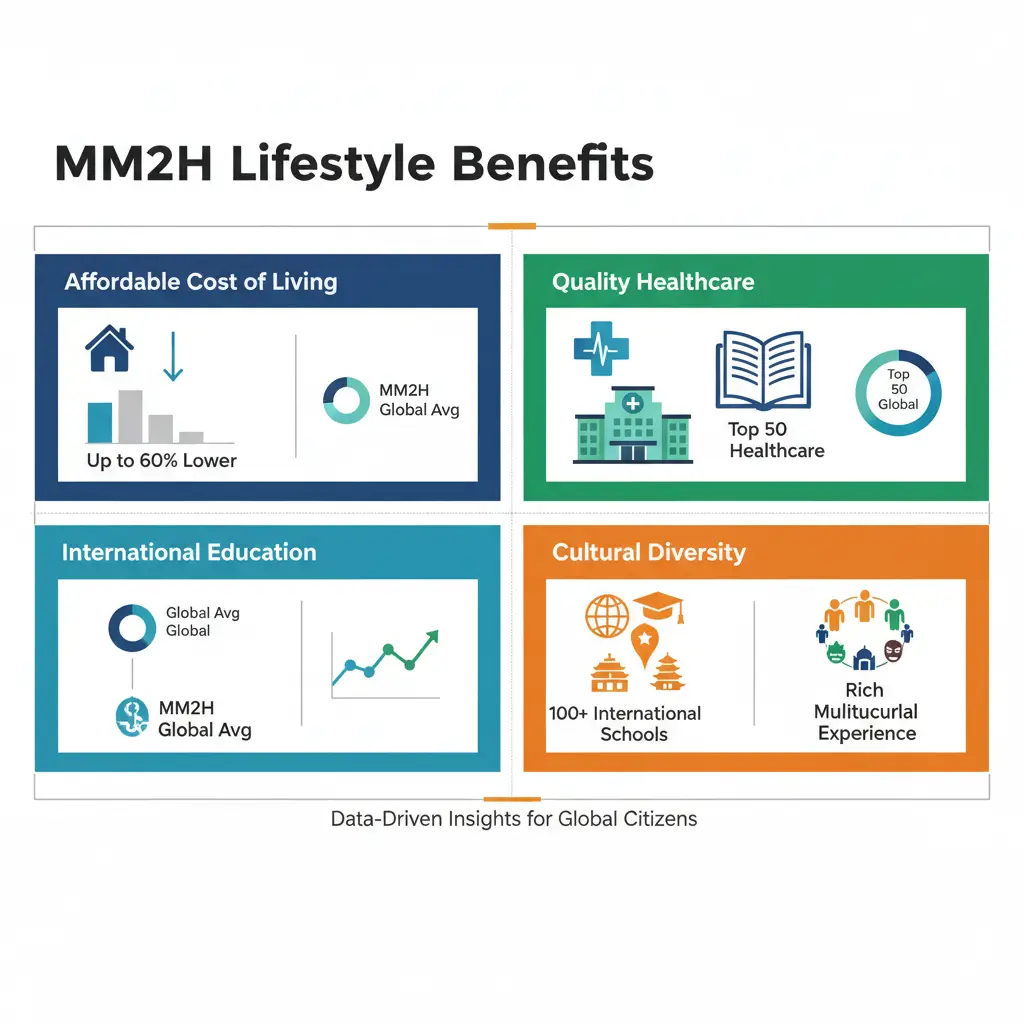
Beyond the visa itself, MM2H residency unlocks a lifestyle rich in cultural experiences, economic advantages, and unparalleled convenience. It’s an opportunity to embrace a diverse, tropical environment without sacrificing modern comforts or financial stability.

Participants gain access to Malaysia’s robust infrastructure, including affordable and high-quality healthcare, diverse international education options, and a vibrant culinary scene. The program also offers certain financial incentives, such as tax exemptions on offshore income and the ability to purchase property. A 2023 expat survey by InterNations ranked Malaysia among the top 10 countries for ease of settling in and quality of life, with 85% of respondents expressing satisfaction with their social life.

Cost of Living: A Major Draw

One of Malaysia’s most compelling advantages is its significantly lower cost of living compared to many Western countries, allowing MM2H participants to enjoy a higher quality of life with their existing income. This affordability extends across housing, food, transportation, and entertainment.

For instance, a spacious apartment in a prime Kuala Lumpur neighborhood might cost 30-50% less than a comparable unit in London or Sydney. Groceries, dining out, and domestic help are also remarkably inexpensive. According to Numbeo’s 2026 Cost of Living Index, consumer prices in Kuala Lumpur are 60% lower than in New York City, with rent prices 85% lower. This financial leverage allows MM2H residents to allocate more resources to travel, hobbies, or savings.

Healthcare Access and Quality

Malaysia boasts a dual-tier healthcare system, offering both public and private options, with private hospitals renowned for their modern facilities, highly trained medical professionals, and competitive pricing. MM2H participants are required to have medical insurance from a Malaysian provider, ensuring access to these services.

The country has emerged as a leading medical tourism destination, attracting patients globally for its quality and affordability. A 2025 report by the International Medical Travel Journal highlighted Malaysia’s private healthcare sector for its advanced technology and English-speaking staff, making it particularly appealing to expatriates. The cost of many medical procedures in Malaysia can be 50-70% lower than in the US or UK, without compromising on standards.

Education Opportunities for Dependents

For MM2H participants with school-aged children, Malaysia offers a wide array of international schools providing curricula from various countries, including British, American, Australian, and International Baccalaureate (IB) programs. These schools maintain high academic standards and often feature state-of-the-art facilities.

The presence of numerous reputable international schools, particularly in major cities like Kuala Lumpur, Penang, and Johor Bahru, ensures that children of MM2H residents can receive a world-class education. Tuition fees, while substantial, are often more competitive than equivalent institutions in other developed nations. A 2024 study by the International Schools Consultancy (ISC) found over 170 international schools in Malaysia, enrolling over 80,000 students, reflecting the robust demand and supply in this sector.

Cultural Integration and Community

Malaysia’s multicultural fabric, comprising Malay, Chinese, Indian, and indigenous communities, creates a unique and enriching environment for MM2H residents. English is widely spoken, especially in urban areas, easing communication and integration.

The country’s diverse festivals, culinary traditions, and religious practices offer endless opportunities for cultural immersion. Expatriate communities are well-established, providing social networks and support systems for newcomers. This blend of local charm and international familiarity makes Malaysia an easy place to call home. The vibrant food scene, a testament to its cultural diversity, is often cited as a major highlight by expats.

Infographic detailing the lifestyle benefits of the Malaysia My Second Home (MM2H) program

What Are the Common Misconceptions About MM2H?

Despite its popularity, the MM2H program is often subject to several misconceptions that can lead to unrealistic expectations or unnecessary apprehension. Clarifying these points is essential for a well-informed decision.

Many believe MM2H is a path to permanent residency or citizenship, which it is not; it’s a long-term social visit pass. Others might underestimate the financial commitment or the importance of using an authorized agent. Understanding the program’s true nature and limitations helps applicants approach it with clarity. For example, a 2023 survey by an MM2H agency revealed that 40% of initial inquiries mistakenly believed the program offered citizenship after a certain period.

Myth 1: MM2H Leads to Permanent Residency or Citizenship

The MM2H program grants a long-term social visit pass, which is renewable, but it does not confer permanent residency or citizenship in Malaysia. Participants remain citizens of their home countries.

This distinction is crucial. While the MM2H visa allows for extended stays and multiple entries, it does not grant the same rights as a permanent resident or citizen, such as voting rights or automatic access to certain public services. The program is designed for those seeking a long-term second home, not a change of nationality.

Myth 2: It’s Easy to Get a Job with MM2H

While MM2H participants are permitted to work part-time (up to 20 hours per week) under specific conditions and with prior approval, the program is not primarily a work visa. Employment opportunities are typically limited to specialized fields or senior positions, and obtaining approval can be challenging.

The primary intent of MM2H is to attract individuals who are financially independent. Those seeking full-time employment should explore other visa categories, such as employment passes, which have different requirements and objectives. The Ministry of Human Resources reported in 2024 that less than 5% of MM2H holders actively sought and received approval for part-time work.

Myth 3: The Fixed Deposit is Untouchable

The fixed deposit requirement, while substantial, is not entirely untouchable. MM2H participants are allowed to withdraw up to 50% of the fixed deposit amount after one year for approved expenses.

These approved expenses typically include property purchase, healthcare costs, education fees for dependents, or car purchase. This flexibility ensures that a significant portion of the deposit can be utilized to support the participant’s lifestyle in Malaysia, rather than remaining locked away indefinitely.

Is MM2H Right for You? Evaluating Your Goals

Deciding if the MM2H program aligns with your long-term goals requires a thorough evaluation of your financial situation, lifestyle preferences, and aspirations for a second home. It’s a significant commitment that should be approached with careful consideration of both the benefits and the practicalities.

Consider your priorities: Is it a lower cost of living, access to quality healthcare, a vibrant culture, or a strategic base for travel? The program offers a compelling package for many, but it’s not a one-size-fits-all solution. A 2024 survey by ExpatFinder revealed that 78% of expats who chose Malaysia cited lifestyle and cost of living as primary motivators, indicating a strong alignment with the MM2H program’s offerings.

Financial Readiness and Long-Term Planning

Your financial readiness extends beyond simply meeting the minimum MM2H requirements; it involves a comprehensive long-term financial plan. This includes budgeting for daily expenses, potential property purchases, healthcare, and education for dependents.

While Malaysia offers affordability, maintaining a comfortable lifestyle requires prudent financial management. Consider consulting a financial advisor specializing in expatriate finances to ensure your assets and income are structured optimally for your move. This proactive planning helps mitigate unforeseen financial challenges and ensures sustained enjoyment of your Malaysian life.

Lifestyle Alignment and Cultural Openness

A successful transition to life in Malaysia hinges on your willingness to embrace a new culture and adapt to different social norms. While English is widely spoken, an openness to local customs and languages will significantly enhance your experience.

Malaysia’s diverse cultural landscape offers rich experiences, but it also requires a degree of flexibility and respect for local traditions. Engage with local communities, explore different cuisines, and participate in cultural events to fully immerse yourself. Those who approach the move with an adventurous spirit and cultural curiosity tend to thrive most.

Proximity to Family and Travel Accessibility

Consider Malaysia’s geographical location relative to your home country and other destinations you frequently visit. Kuala Lumpur International Airport (KLIA) is a major regional hub, offering excellent connectivity to Asia, Australia, and beyond.

For many, Malaysia serves as an ideal base for exploring Southeast Asia due to its central location and robust flight network. This accessibility can be a significant factor for those who wish to maintain close ties with family abroad or indulge in extensive regional travel. A 2025 report by OAG Aviation Worldwide ranked KLIA among the top 20 busiest airports in Asia for international connectivity.

Frequently Asked Questions About MM2H

Can MM2H participants buy property in Malaysia?

Yes, MM2H participants are permitted to purchase property in Malaysia, subject to state foreign ownership rules and minimum price thresholds. These thresholds vary by state, but generally aim to prevent foreign buyers from competing for lower-priced housing. It’s advisable to consult with a local property agent to understand the specific regulations in your desired location.

Is the MM2H visa a work visa?

No, the MM2H visa is primarily a long-term social visit pass and not a work visa. While participants aged 50 and above may apply for permission to work part-time (up to 20 hours per week) in approved sectors, this is subject to strict conditions and prior approval from the Immigration Department. The program is designed for financial independence.

Can I bring my family under the MM2H program?

Yes, MM2H participants can include their spouse and unmarried children under the age of 21 (or 34 if still pursuing higher education) as dependents in their application. Parents or parents-in-law over the age of 60 can also be included, subject to additional financial requirements for their care. Each dependent will receive their own MM2H social visit pass.

What happens if I don’t meet the minimum stay requirement for Sarawak MM2H?

For the Sarawak MM2H program, participants are required to stay a minimum of 30 days per year in Sarawak. Failure to meet this requirement without valid reasons could lead to the revocation or non-renewal of your MM2H visa. It’s important to keep track of your days in Sarawak if you opt for this specific program.

Are there any tax benefits for MM2H participants?

MM2H participants generally enjoy tax exemption on all offshore income remitted into Malaysia. However, income earned from within Malaysia (e.g., from approved part-time work or local investments) is subject to Malaysian income tax. It’s always recommended to seek advice from a tax consultant specializing in Malaysian tax laws for expatriates.

Can I withdraw my fixed deposit if I decide to leave the MM2H program?

Yes, if you decide to terminate your MM2H visa, you can withdraw your entire fixed deposit amount, provided all outstanding liabilities in Malaysia are settled. The process involves informing the MM2H Centre and the bank, and it typically takes some time to process the withdrawal and final exit formalities.

What are the main differences between the Peninsular and Sarawak MM2H programs?

The main differences lie in their eligibility criteria, particularly financial requirements, and the administering authority. Sarawak MM2H generally has lower income and fixed deposit thresholds and is managed by the Sarawak state government, with a requirement for participants to spend a minimum number of days in Sarawak annually. Peninsular MM2H has higher financial bars and is managed by the federal government, with no specific stay requirement.

Last updated: April 30, 2026


????

發佈留言必須填寫的電子郵件地址不會公開。 必填欄位標記為 *

zh_TWChinese (Taiwan)